Showing posts with label cinematheque. Show all posts

Wednesday, February 2, 2011

Tokyo After Midnight: a B-movie Mystery

 [Part 5 in the story of my mother LeAnn Bartok’s lost career in Japanese movies in 1959-1960 – and the search to find some trace of it over thirty years later.]

In January 1998, I received another letter from Motomu Ida, the director of Kimi Wa Nerawareteiru:

 “Dear Dennis –

Thank you for your letter … I was surprised to learn, after so many years, that your mother was an American actress.  No wonder she was so good in the film.  I was told by the Nikkatsu casting department only that she was married to someone who worked at an American military base.  Had I known that she was an actress I am sure I would have asked her to appear in several more of my films.  I used to be very fond of using foreigners with Japanese subtitles on screen.  What a shame.  I can still remember her moving speech with menace in her voice.

As Nikkatsu has since gone bankrupt, there is no hope to do anything further.  I have been told that no one knows where the positives and negatives might be stored.

I am sorry to hear that your mother is not feeling well.  I wish her a speedy recovery.

Although your kind words were heartwarming, I did not do anything out of the ordinary.  I am just happy that I could be of some use …

These days I teach performers and technical staff at a film school.  After all I am getting old, you see.

Motomu Ida”


This wasn’t a complete surprise to me.  The little I’d heard about Kimi Wa Nerawareteiru led me to believe it was one of the quickie, hour-long B-movies that Nikkatsu churned out to fill the bottom half of their weekly double-bills.  The film had never been released on VHS or DVD in Japan; none of the film archives or libraries I’d contacted had ever seen a copy.

It was just a commercial little action film that came and went, and was now lost in limbo somewhere.

I never expected that if and when Kimi Wa Nerawareteiru came to light, it would turn out to be some lost classic of Japanese cinema. 


My reasons for finding it were purely selfish.  My mother was in it.

In 2001 I took my first trip to Japan traveling with my Cinematheque colleague Chris D. and my best friend Tom Abrams.  I took Xeroxed copies of the script pages for LeAnn’s movie with me and handed them out to whoever I met at film archives, film clubs etc., on the slender chance someone somewhere would have come across a print of the movie.


In Osaka we met with a wonderful guy who ran a movie theater the size of a shoe-box with a projection booth you could barely squeeze into.

Upstairs his office was filled with stacks of film prints leaning haphazardly everywhere.  It was the kind of place I recognized from film collectors in L.A.  


When I asked if he’d ever seen a print of Motomu Ida’s Kimi Wa Nerawareteiru, he scrunched his face for a moment then shook his head.  No, never seen it.

I even met with someone from Nikkatsu who took the Xeroxed pages I offered, said they’d look into it, with no result.

We had lunch with Kinji Fukasaku and his son Kenta, fresh off their incredible triumph with Battle Royale (which Kenta had written).  Kinji looked great.  He was already prepping for the sequel Battle Royale II which he hoped to get into production soon. 

No one knew it then but time was running short for him, too.  He’d been secretly battling cancer for several years which had gone into remission, and then returned.

With Chris and Tom and our chanbara-loving buddy, Yoshiki, we bummed around Tokyo and Osaka, seeing as much as we could, buying as many Japanese movie posters as we could carry.  We made a midnight visit to one of Japan’s oldest movie studios with the mild-mannered head archivist, who turned out to have a very odd addiction (more on that in another blog.)

It wasn’t the Japan that LeAnn knew in 1959 any longer.


But it was killer.


I came back to the U.S. loaded down with stories and souvenirs for her.

Two months later my mother LeAnn died.  She was at home in her New York apartment with my sister Shari and younger brother Jayce.

Her last conversation was talking with Mark Toscano, then at Canyon Cinema, about her films of the Skyworks multiple-mile drops.  Right up until the end, she was still talking about the movies.  She hung up the phone and moments later she died.


She never got to see Kimi Wa Nerawareteiru again, but she did get to hear from the director, Motomu Ida, and that was something pretty amazing.

Much more important, LeAnn’s love for Japan never left her. 

She’d gone many places and done many things but Japan was always someplace special.  When she taught herself to paint in the late 1960’s, some of her first works were a copy of a fierce temple guardian she’d seen in Japan, from the 9th or 10th century, and a primitive, lovely image of the baby Jesus, Mary and Joseph, all with Japanese features.


[Above:  LeAnn Bartok -- painter, conceptual artist, avant-garde filmmaker and actress in Japanese movies -- in New York City, late 1980's]

The last great cycle of paintings she did before her death were over 150 views of Mt. Fuji, with the mountain, golden and radiant, surrounded by her red Skyworks mile streaming overhead:


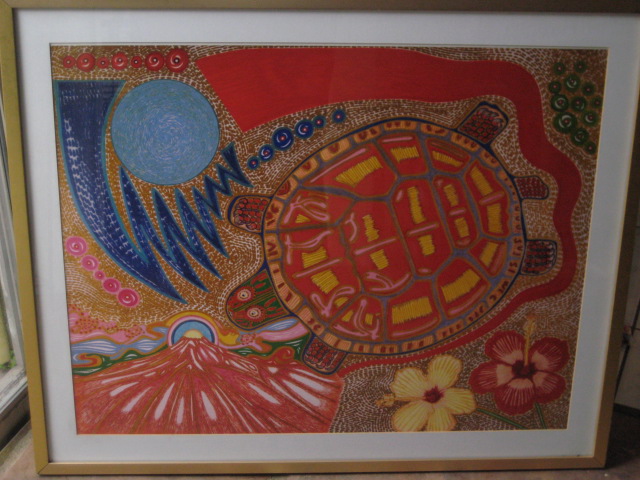


[Above:  two of LeAnn Bartok's Mt. Fuji series of paintings with close-up details]

I was beyond heartbroken, as were my two brothers and sister.  I woke up the morning after she died and the world seemed like a cold, unfamiliar place that I no longer recognized or wanted to be a part of.

I returned to Japan in March, 2002, this time with my then-girlfriend (now wife) Susan.  The sakura cherry blossoms were blooming early that year.   We had some wild adventures, culminating in a haunting, disturbing episode where we found the body of a man who’d just hanged himself, in the forest behind the cemetery in Kyoto’s Nanzenji Temple, and then led the Kyoto Homicide Squad back to where the body was hanging.

There were strange spirits in the air.

During the trip, my friend Isao Tsujimoto at the Japan Foundation had arranged for me to meet with Tadao Sato, an elegant and thoughtful man who is one of Japan’s best known and most influential film critics.  (In December 2010 he was given the 38th Japan Foundation Award for Arts & Culture in recognition of his efforts to introduce films from across Asia to Japanese audiences.)

Over coffee I told Sato the oft-repeated story of LeAnn and Kimi Wa Nerawareteiru.  In some ways I was more determined than ever to find the movie – it was a link to her past, one that she was no longer around to share with us.  Sato listened to the story with polite interest and took the Xeroxed pages of the script I offered to him.

I thought nothing more would come of it.


(Next chapter:  Kimi Wa Nerawareteiru, the lost movie)

[All photos of LeAnn Bartok and artworks:  Copyright, courtesy Estate of LeAnn Bartok.]


Wednesday, January 26, 2011

Tokyo After Midnight: a B-movie Mystery

[Part 4 in the story of my mother LeAnn Bartok’s lost career in Japanese movies in 1959-1960 – and the search to find some trace of it over thirty years later.]

In June 1997, the Cinematheque presented a sold-out screening at the DGA of the 1973 yakuza epic Battles Without Honor & Humanity (Jingi Naki Tatakai.)  It was an amazing reception for a film that had been virtually unknown in the U.S. for almost 25 years.

After the screening William Friedkin interviewed the director of the film, a legendary helmer of that most hardboiled of all Japanese film genres.  A hard man to impress, even he was astonished at the turn-out.  “What are all these people doing here?” Kinji wondered aloud.


[Above, right:  Kinji Fukasaku, one of Japan's greatest filmmakers, with Toshiko Adilman on the streets of Tokyo]

Kinji Fukasaku was in his late 60’s at the time.  White haired, eyes usually hidden behind enormous sunglasses.  Extremely articulate to the point of being long-winded (I’ll never know how his great friend and translator, Toshiko Adilman, managed to keep up with him during Q&A’s.)  He inspired a kind of fierce loyalty and devotion from his inner circle of friends. 

I nicknamed him “oyabun” after the term of respect given mob bosses in his movies.


[Above:  poster for Kinji's 1976 Yakuza No Hakaba (Yakuza Graveyard)]


[Above:  Kinji's 1971 Bakuto Gaijin Botai (Gamblers In Okinawa)]

Kinji was apparently in the waning years of his career at the time, the period when directors start appearing regularly at retrospectives, start thinking of writing their autobiographies.  He’d been directing movies since 1961 – coincidentally right around the time LeAnn was working in Tokyo – and his glory years of brilliant, subversive films like Black Lizard, Under The Fluttering Military Flag, Graveyard Of Honor & Humanity, and especially his awe-inspiring Battles Without Honor & Humanity cycle, were seemingly decades behind him.

Few could anticipate that Kinji would roar back, like a wounded wolf waiting for the chance to strike, with the most ferocious and incendiary Japanese movie of the past decade:  Battle Royale.

It would prove to be his swan song, a summing up of all the explosive anger and violence and distrust for authority that runs through his movies.  A huge screw-you in the face of good taste.

It was the last masterpiece of a great warrior and artist.

Kinji, it turns out, was president of the Japanese Directors Guild at the time.  A good friend to have when you’re looking for lost movies.  He was interested by the story of LeAnn’s career in Japanese movies … He’d never met her or heard of her, that would be too much to expect.  But I think he liked the idea of an American woman very, very far from home, appearing in low-budget Japanese crime movies.  It appealed to his outlaw sensibility.

 He offered to help.

I should say, he and Toshiko Adilman offered to help.  Toshiko was one of Kinji’s most trusted friends, his translator and right-hand woman since they met in 1980 making Virus, his costly, ill-fated sci-fi epic.  During shooting on Virus, the ship he and Toshiko were on hit a reef and they were stranded on Antarctic ice until being rescued by the Chilean navy.  She laughs about it now.  Toshiko is one tough hombre, a truly remarkable woman who wound up being the go-between and translator for Kinji and several other key players in this story.  I can’t thank her enough.

In October 1997, a few months after I met Kinji, I received a message from him via Toshiko:

He had managed to locate the director of the film LeAnn appeared in, Kimi Wa Nerawareteiru, a man named Motomu Ida who was still alive and in very good health.


[Above:  Motomu Ida in 2004 in his office at the New Culture School, Tokyo] 

It was the first really positive news I’d had in my search for some trace of my mother’s Japanese film career.

Ida sent a short message in Japanese, translated as follows:


With it, he included a photo of his own copy of the film's poster:


LeAnn’s name was right there on the poster, 4th billed, written phonetically as "Lyn Barutooku."

As Toshiko later pointed out, Kinji himself had actually borrowed the photograph of the poster from Mr. Ida and arranged to have a copy made for us.

LeAnn and I were both frankly astonished to hear Ida was still alive and that he remembered working with her nearly 40 years earlier.

I wrote back to him a few weeks later:

“Dear Mr. Ida:

I want to personally thank you for your amazing kindness in providing a photograph of the poster for my mother, and writing a note about your memories of her … I hand-delivered it to her a few days ago during the Christmas holidays – she lives in New York City now where she works as a painter.  She was overjoyed to see the faces of actors that she appeared with so long ago, and to read your letter – it brought back many wonderful memories of when she worked as an actress at Toho and Nikkatsu … She was one of the few American actresses living in Japan at the time and she’s always been very proud of her work in your film.

When I was a child growing up, my mother would often speak about Kimi Wa Nerawareteiu, or 'The Man They Tried To Kill' as she called it.  She remembered carrying a gun and a knife in the film, and trying to corrupt the hero of the film.  To be honest, I was always proud of the fact that my mother played such a shady character in a Japanese film – you may not realize it, but your film a great impact on my family, even though none of us had ever seen it!

I’d also like to apologize for the delay in writing back to you – my mother’s been ill for some time and confined to her apartment in New York.  I wanted to deliver the materials to her myself to see her reaction before I wrote back.

Again, I can’t thank you enough … you’ve made both me and my mother very happy.”

I’ve since learned quite a bit more about Ida and his career; he remains a criminally-unknown director outside of Japan. 

 According to the Dictionary of Japanese Film Directors, Ida was born September 3, 1922 in Oe-machi, Kasa-gun, Kyoto Prefecture, and studied Japanese literature at St. Paul University.  He began working in films as an A.D. in the mid-1940’s under director Keigo Kimura at Daiei’s Kyoto Studio; about eight years later he moved over to Nikkatsu where he worked with directors Hiroshi Noguchi and Isamu Kosugi.

He directed his first feature Tokyo Wa Koibito (Tokyo, My Sweetheart) in 1958, and was known mainly for lower-budgeted (“B- and C-class”) mystery/action films starring actors such as Michitaro Mizushima, Yuji Odaka and Hideaki Nitani. 

By today’s standards he was incredibly prolific, directing between 5 and 6 films a year.  In 1960, the year he directed Kimi Wa Nerawareteiru, he also directed:  Devil’s Sigh, A Seductress Without A Shadow, A Man Who Threw Away A Shadow, A Bullet Mark That Disappeared, Bastard and Go To Hell.

The titles alone tell you all you need to know.  Like any number of underrated American directors – William Witney, for example – here was a guy who knew how to turn out tough, hard-hitting little movies that got to the point and wasted no time.

[Left:  Poster for Motomu Ida's 1964 film Kenkajo (Thrown Down The Gauntlet)]

According to the Dictionary, his best-known movies were “Ikite Iru Okami (Live Wolf) – the sad story of a man and woman who lived in the pleasure quarters in mid-Meiji era … Bakuha Sanbyo Mae (Before The Blast) – a full-fledged spy/action film … Tokyo Onna Chizu (Women’s Tokyo Map) – a story of hooligans which was a fore-runner to Nikkatsu’s action movies … and Yoru No Saizensen – Onnagiri (Front Line In The Night:  Girl Hunt).”

[A huge thanks to Toshiko Adilman for her translation of the above.]

It goes without saying that these movies are almost completely unknown in the U.S., even to hardcore Japanese film buffs.  Just another example of how we’ve barely scratched the surface of the vast pool of movies made in Japan in the post-war years.

After directing over 50 feature films, in the late 1960’s Ida moved into television, where he directed approximately 150 more episodes – by his tally nearly 200 film and TV works all together.  A simply staggering number that brings to mind directors of the early silent years; no director working today could ever post such numbers.

The amazingly good news was that Motomu Ida was alive and well.  But what about finding a copy of Kimi Wa Nerawareteiru, the film itself?


[Special thanks to Marc Walkow and Stuart Galbraith for their invaluable help in research for this article.]

(Next chapter:  On the trail of the lost movie)

Friday, January 21, 2011

Tokyo After Midnight: a B-movie Mystery


[Part 3 in the story of my mother LeAnn Bartok’s lost career in Japanese movies in 1959-1960 – and the search to find some trace of it over thirty years later.]

I came to Los Angeles in 1992 and wound up working at the non-profit American Cinematheque, then screening at the Directors Guild theater on Sunset Blvd.  At the time the Cinematheque was screening mainly classic Hollywood films.

Not long after a guy walked into my office carrying two shopping bags.  He was a solitary, intense-looking character:  bushy black eyebrows and the dead-calm, disinterested stare of a professional hitman.

He asked if I was interested in showing any overlooked Japanese movies.  The bags were filled with home-made VHS tapes from his enormous personal collection, films by then-unsung genre masters like Kinji Fukasaku, Hideo Gosha, Kihachi Okamoto, Tai Kato.

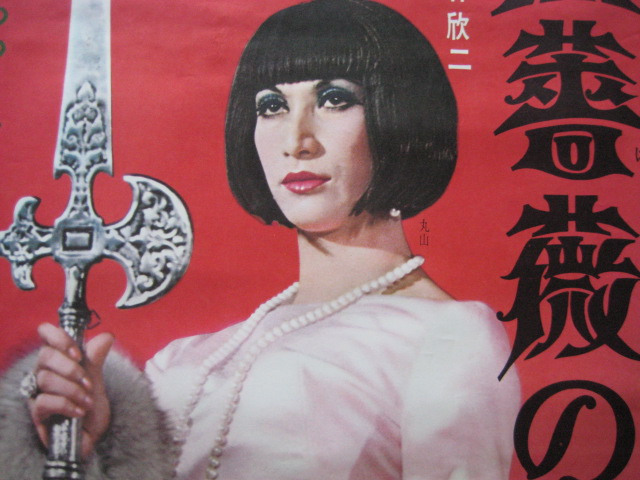
[Above:  image from Japanese 2-sheet poster for Kinji Fukasaku's subversive Black Rose Mansion (1969)] 

Chris D. remains one of the most fascinatings guys I’ve met out in L.A.  Punk rock singer and founder of The Flesheaters … indie director, writer, and actor as well as poet and lyricist (the recent anthology “A Minute To Pray, A Second To Die”) … He’s also, for the purposes of this story, a walking library on Japanese cinema from the 1950’s & 1960’s to today.  His book of essays and interviews “Outlaw Masters Of Japanese Film” is essential reading for anyone interested in this subject.


[Above:  Chris D. and our good friend Yoshiki Hayashi, who was enormously helpful in the hunt for LeAnn's films, in Tokyo in 2001]

Chris's love, and his knowledge, of these movies has a kind of incandescent, almost religious, fervor to it.  He’s a dark preacher thundering on about films with titles like Go Go Second Time Virgin, The Age Of Assassins and Graveyard Of Honor & Humanity.

Guided by Chris’s expertise – and partly inspired by my own unusual family connection to Japanese movies – the Cinematheque started screening dozens of unseen Japanese genre films in its annual Outlaw Masters of Modern Japanese Film series.

Our partner in crime was another man who’d prove instrumental in learning more about my mother LeAnn’s brief career in Japanese films:  Isao Tsujimoto, then Director of the Japan Foundation’s L.A. office.

A spry, extremely cultured man with a mischievous wit, Isao turned out to nurse a secret passion for the same kind of subversive Japanese genre films Chris and I loved.  He remembered camping out in movie theaters in Japan in the late 1960’s as a student to see the latest yakuza films.  “As students we felt a kind of kinship with the yakuza anti-heroes,” he recalled.  “They were outcasts and rebels like us.”  It was Isao in fact who came up with the “Outlaw Masters” moniker.


[Left to right:  Isao Tsujimoto of the Japan Foundation, Susan Gold -- and the man who'd play a key role in the hunt for LeAnn's lost movie] 

Isao used his considerable influence to strike new 35 mm. prints of previously unseen films like Koji Wakamatsu’s scandalous Go Go Second Time Virgin and Ecstasy Of The Angels.  (Wakamatsu remains persona non grata with the U.S. State Department, unable to travel to America, as we found out when we tried to bring him in for one of our series.)

From me, Isao and Chris both heard the story of my mother LeAnn’s time in Japan and the few tantalizing details I had about her film career.  We made some inquiries -- but Nikkatsu’s Kimi Wa Nerawareteiru from 1960 turned out to be beyond obscure. 

It was completely unknown.  No one we met had ever heard of or seen it.

During this time my mother LeAnn’s health grew progressively worse from asthma she’d developed in the late 1970’s and from the onset of adult diabetes.  She lived in Manhattan with my older sister Shari and younger brother Jayce, and we stayed in touch through almost daily phone calls.  Money was always a huge worry.

LeAnn and Shari practically begged me to help find a copy of one of her Japanese movies; it was a formative period in LeAnn's life that had obviously influenced and inspired her as a filmmaker and artist.


[Above:  LeAnn Bartok during performance art event at the Annual New York Avant- Garde Art Festival at the Passenger Ship Terminal in New York in the early 1980's]

Still, I had no success in finding a copy of Kimi Wa Nerawareteiru or any other movie she made in Japan in 1959-1960. 

It felt frustrating:  my job was to ferret out lost and overlooked movies, I was essentially a film detective – and here I couldn’t find any trace of LeAnn’s film career.  Not even a still photo.  What kind of a son was I?

I knew on some level that time was running short for her.  She’d been taking doses of steroids to control her asthma since the late 1970’s – as we later learned these can have serious side effects including a weakened heart and periods of deep depression.  The diabetes only made a bad situation worse.  But it’s hard to confront these things when it’s your own parent.

I loved my mother deeply, and struggled as a child growing up to understand and appreciate her work as an artist …

It was difficult and all right at the same time, to borrow a phrase from one of her favorite writers, the great New York poet Frank O’Hara.  I could feel utterly helpless at her titanic fits of temper.  Ashamed and useless at her weeks-long bouts of illness and labored breathing, frustrated that I couldn’t do anything to help.  So I’d retreat into the false safety of my own world of movies and vinyl records.

I know now that it’s almost impossible for someone on the outside to understand what it’s like to live with chronic illness on a daily basis.

Only slowly could I get some distance and really begin to see her as an artist.  As a kid growing up, it was just what she did.  There were paintings everywhere in our house, we leaned against them watching TV … there was a Bolex camera and editing bench in the basement.  My brothers and sister and I ran around the desert, laughing, helping her gather the fallen streamers from her mile-length drops.  We thought it was fun.


[Above:  poem by LeAnn Bartok circa 1976]

Growing up in suburban Pittsburgh in the 1970’s, I was sometimes even embarrassed by her strangeness, her refusal to fit in:  Why did she have to throw art out of airplanes?  Why did she drive around in a van wearing a black cowboy hat like a female trucker?

I was a kid, what did I know?  I knew she was different. 

Ironically there’s a famous saying in Japan, “The nail that sticks out gets hammered down.”  My mother was definitely the nail that sticks out.


(Next chapter:  Kinji Fukasaku, yakuza master)

[All photos, artwork and text by LeAnn Bartok:  Copyright, courtesy of Estate of LeAnn Bartok]

Sunday, January 16, 2011

Tokyo After Midnight: a B-movie Mystery

[Part 2 in the story of my mother LeAnn Bartok’s lost career in Japanese movies in 1959-1960 – and the search to find some trace of it over thirty years later.]

Living alone in Tokyo, barely able to pay the rent, my mother LeAnn felt disoriented, stranded.  She looked into working as a nurse but her lack of Japanese, and the low nurses’ pay, forced her to look for better-paying work.  She wound up teaching English to future Toyota executives, who treated her like a member of the family; during the brutal student riots in 1960 she remembered several of her pupils coming to class bruised and bloodied.  Despite high anti-American sentiment in Japan at the time -- students were protesting the country’s entry into a security treaty with the U.S. – she never personally saw any sign of prejudice. 


[Above:  modeling photo of LeAnn taken at Tokyo steakhouse in 1959; this was apparently used in a Toyota sales brochure]


To this day I look at movies shot in Japan in the late 1950’s and early 1960’s and try to imagine what it looked like then.  The Tokyo my mother would’ve known.  I’ve been there several times myself, but it’s changed so radically.  One night out walking with my friend Isao Tsujimoto he stopped and pointed at an enormous row of buildings:  “when I was young those were nothing but empty lots,” he said, trying to remember the city that was lost and would never return.

Years later, after LeAnn had trained herself to become a painter and avant-garde filmmaker, random memories of that long-past time in Tokyo would come floating by, like pages ripped from a diary and tossed in the stream …

A photographer noticed her on the street – she would’ve stood out, a young American woman in Tokyo – and hustled her to take a picture.  

Through him she met the man who was instrumental in getting her into the movies:  Osman “Johnny” Yusuf.

If you look him up on IMDB you’ll find more than half-a-dozen screen names including “Johnny Osman,” “Yusef Toruko” and more.  Fitting for a guy who worked as a part-time agent, actor and pimp.

 Details are fuzzy on Yusuf:  he was apparently born in Turkey, although he told my mother he was a “white Russian.”  It could be true:  his birthdate is listed as 1920, perhaps his family escaped from Russia to Turkey and he kept referring to himself by the mother country.  (My friend, the director Hubert Cornfield, was born in Istanbul but insisted his family was Greek, not Turkish, even though they’d left Greece many decades earlier.)

You can spot Yusuf briefly in any number of Japanese monster movies including Mothra, King Kong Vs. Godzilla, Battle In Outer Space and Son Of Godzilla, sometimes playing a submarine crewman or innocent bystander.  Many years later when LeAnn was watching one of the Godzilla films with my brother Jayce she suddenly exclaimed, “Look, there’s my agent – he’s the one with the ray-gun.”

Yusuf took an immediate shine to LeAnn – she later claimed he was “in love with her,” although whether this was romantic or just paternal/friendly I never learned – and introduced her to his contacts at the Japanese studios.


Yusuf was apparently a good man to know in Tokyo, if you were a man:  in addition to working as an actor and agent, he’d occasionally field late-night phone calls from executives who’d noticed some attractive Japanese starlet on screen.

If the actress was hungry enough – and pay in Japanese movies, then as now, was pretty weak – she’d agree to a date.  As in Hollywood, young girls were easy prey.


Maybe because she was American, maybe because he nursed a secret crush on her – but Yusuf apparently never tried to rope my mother into his sideline prostitution business.   She knew what he was up to, but she still liked the guy.  I like the guy too, in a strange way.  He sounds a bit like Ben Gazzara in Bogdanovich’s Saint Jack.

The Japanese film industry in the early 1960’s could almost rival Hollywood in sheer volume and variety.  The major studios – Toho, Toei, Nikkatsu, Daiei, Shochiku and smaller distributors – were churning out hundreds and hundreds of pictures a year.  Almost as important, they controlled vast chunks of Tokyo real estate where they shot their yakuza crime films, chanbara wandering gambler movies and more.  (Over a decade later, when the Japanese film industry more or less imploded in the mid-1970’s, several studios survived by becoming, essentially, real estate companies.)

It was a great time to be in the movies, in Japan in 1960.  She wound up working for Nikkatsu and Toho studios.

And there the details of her story ended, more or less.


There were other memories, here and there: 

Vague recollections of various acting jobs.  A lunch one day with Toshiro Mifune.  How she got a part in a movie injecting a man with a needle because she was a trained nurse.  How they bleached her hair so badly in another it began to fall out and they frantically rubbed fish oil into her scalp to save it.

But just bits and pieces.  No names of film titles or directors she worked with, no paper trail to follow (not surprising:  now as then, many Japanese film deals are done by handshake, with no formal contract.)

Except for one movie:  Kimi Wa Nerawareteiru, a Nikkatsu film from 1960 directed by Motomu Ida.

[Above:  original speed poster for Kimi Wa Nerawareteiru.]

For some reason LeAnn saved the first two pages of the script for Kimi Wa Nerawareteiru, translated into English with the film’s title at the top. 


Maybe she saved it because it was one of her bigger film parts:  she remembered playing the boss of a narcotics gang.  Carrying a pistol in her stockings.  Smacking the hell out of people.

One of the characters in it was named “Henry Yamanaka,” that much she remembered clearly.  I heard the name “Henry Yamanaka” growing up so often I thought he was a real person.

Not long after making Kimi Wa Nerawareteiru she got pregnant.  (The bad joke around my family growing up was that my sister had “Made in Japan” stamped on her feet.) 

LeAnn left Tokyo and returned to the states, where she would re-emerge a decade later as her own unique breed of cowboy-hat wearing, mile-length streamer throwing avant-garde filmmaker.


(Next chapter:  Trying to pick up the trail 30 years later.)